

Member Spotlight: Gender Justice Fund
By: Alexander Lee on October 6, 2025
Our Member Spotlight series continues, where we’ll regularly showcase the vital work being done within our network.
We are excited to feature Gender Justice Fund.
If you’d like to be considered for a feature, please contact our Interim Director of External Affairs, Amara Reese-Hansell at [email protected].
What’s a significant accomplishment from the last few years that Gender Justice Fund is particularly proud of?
It’s hard to name a single one. Honestly, we’re mostly just proud of how much we’ve accomplished as an organization since we became the Gender Justice Fund in 2020. The scope and reach of our work have broadened exponentially since then, and we have a much more expansive and diverse community among our board, grantees, and partners. In the past five years, we’ve made over $2.6 million in grants, almost a million more than we awarded in the previous 15 years. We’re also supporting many more grantees than before, addressing a range of issues including reproductive justice, consent–based sex education, labor rights, and sex worker liberation.
But I would have to say that the Trans Resilience Fund is a singular achievement that we’re especially proud of. The Trans Resilience Fund is a pooled, participatory grant program through which we’ve moved over $800,000 to trans communities in and around Philadelphia. When we launched the Fund in 2021, we expected it to be a one-time project. But we had so much buy-in from grantees, funding partners, and members of our grantmaking committee (who are primarily BIPOC trans and nonbinary people), that we knew we had to try to keep it going. Now, we’re well on our way to reaching a milestone of $1 million in cumulative grantmaking by the end of our 2026 round. We didn’t realize when we started how few dedicated streams of funding there are for trans issues nationally, and we’re extremely proud and grateful to be able to do this work in partnership with local trans communities.

GJF executive director and board members receiving the “Robin Hood Was Right” award from Bread & Roses Community Fund at their annual Tribute to Change event in 2024. This award is given to an individual or group making an outstanding contribution to social change philanthropy in the Philadelphia region.
Why does Gender Justice Fund believe increasing resources for LGBTQ+ communities is crucial in this moment?
Well, there were never enough resources for LGBTQ+ communities to begin with, so it was always a good time to increase funding. One of the most obvious reasons is that it’s especially important now, given the attacks on LGBTQ+ communities — especially trans communities – at federal state and local levels. We are seeing rights stripped away and LGBTQ+ people and groups being increasingly scapegoated and facing threats to their safety.
But another very good reason to fund LGBTQ+ communities right now is that they know how to organize, and have been on the forefront of social movements for decades. From Bayard Rustin to Marsha P. Johnson to Alicia Garza, LGBTQ+ leaders have played key roles in major civil rights movements throughout history. As authoritarianism and fascism spread in this country, we need to resource the people and organizations who understand how to build partnerships, how to keep each other safe through community networks and mutual aid, and how to resist in the face of what might seem like impossible odds.
We also know that there is a narrow window of opportunity to create a mass movement that pivots us away from where this country is currently headed, so the time to move money is now. The best time was yesterday, but the second-best time is now.

GJF board members at their annual board retreat in Fall 2024
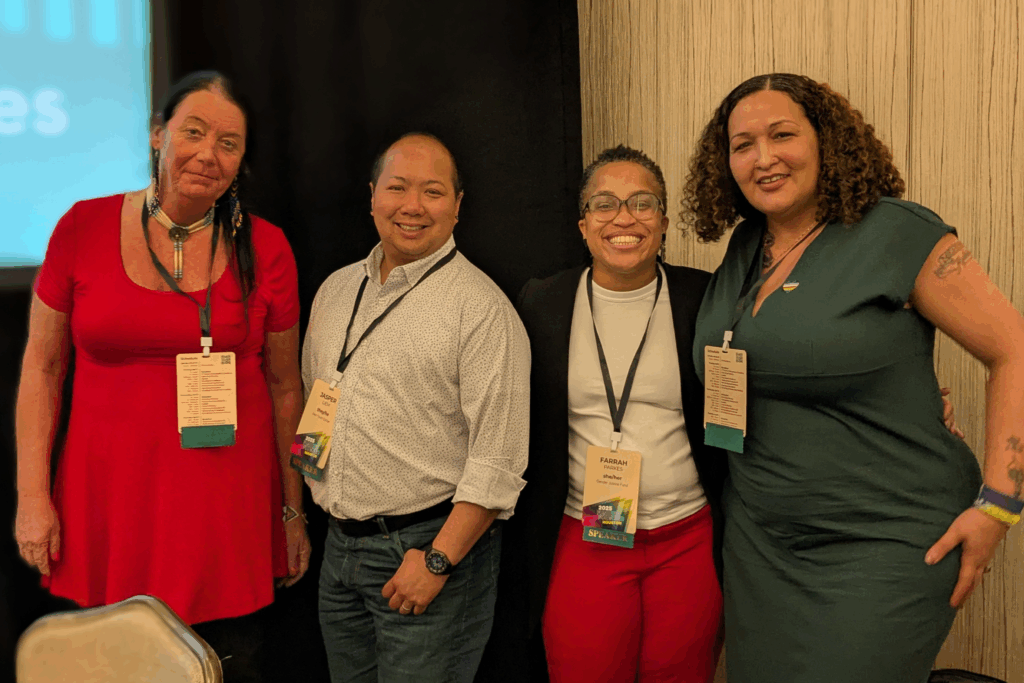
GJF Executive Director Farrah Parkes, with board members Naiymah Sanchez and Janis Stacy at Funding Forward 2025, alongside Jasper Liem, Executive Director of Trans Resilience Fund grantee organization Attic Youth Center
If Gender Justice Fund had a mascot, what would it be & why?
It might sound weird, but we think our mascot would be a sassy ant. We’re based in Philly, where Gritty is from, so our mascot game is strong– we wouldn’t be just any old ant. Ants are small, but they can lift up to 50 times their weight. People are always surprised that we only have two staff members at Gender Justice Fund, given the amount of heavy lifting we do every day. Like ants, we work hard and everything we do is done in community: we know that our movements are more powerful when we’re aligned and moving in the same direction. We couldn’t do the work we do without our partners, our dedicated board, and our grantees.
Ants are also persistent, strategic, and relentless. Like us, they’re sneaking into the picnics and the tables not meant for us, and trying to get some goodies to take back to their communities. And they’re everywhere; you can’t get rid of them. We are always going to show up at philanthropy tables to argue for more inclusion, for more intersectionality, for power sharing, and for our collective liberation. And mainstream philanthropy might roll their eyes and be annoyed. But we’re still going to be there.
When you think about Gender Justice Fund’s journey towards grantmaking and resourcing LGBTQ+ communities, is there anything you could use support or thought partnership on from your peers in the Funders network? Or are there any recent learnings you’re excited to share with the network?
We’re really excited to share a new report on the impact of our Trans Resilience Fund. V Chaudry, a researcher based at Brandeis University, worked with us to document the first round of the fund, and we asked them to come back earlier this year to hear from grantees and members of the grantmaking committee about the fund’s impact. Some of the findings were things we had observed ourselves over multiple grant cycles. One finding was that although the grants were relatively small, they had a big impact because they could be used to provide direct financial support to trans people, which is relatively uncommon with grant funding. We also knew some grants served as catalysts for other types of funding and program development within grantee organizations.
However, there were also a couple of surprises. We didn’t realize how much our grantees benefited from what we thought of as relatively basic networking opportunities and how much the project contributed to professional and leadership development. The full report is up on our website, and we invite you all to take a look.
